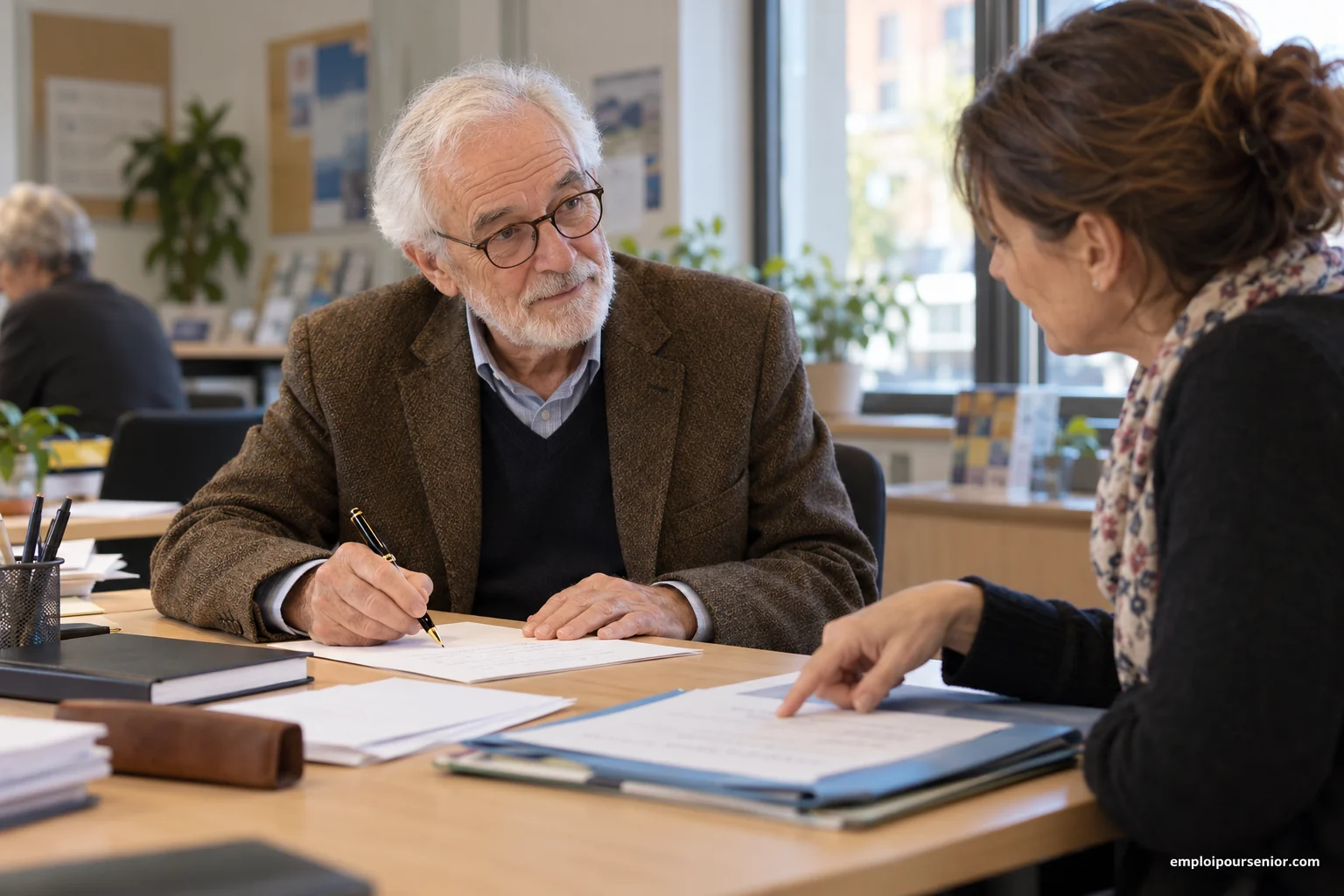
Public writer after 50 refers to a person in the French tradition of the écrivain public, a professional who writes for others. People who hesitate in front of a blank page, who struggle with written French or who simply lack time hand over a text: an administrative letter, a cover letter, a complaint, a thank-you note, a speech, a presentation file or a life story meant for the family. The writer does not write in their place without consulting them, because the text must remain the client's own, in their words and with their intention.
What a public writer actually does
A public writer is a professional who writes on behalf of other people. Clients who freeze in front of a blank page, who struggle with formal written French, or who simply lack the time hand over the drafting of a text. The aim is never to write for them without asking questions: the finished piece must remain the client’s own, with their words, their intention and their tone.
Requests are varied. They include administrative letters, cover letters, complaints, thank-you notes, speeches for a wedding or a leaving party, presentation files and also life stories meant for the family. Some writers specialise in a single type of text, while others stay generalists.
In France the occupation is not a regulated profession, and the title is not protected in the way a medical or legal title is. That is why reputation, a clear method and transparent pricing matter so much.
Who this activity suits after 50
This path tends to suit people who wrote a great deal during their working lives: former teachers, executive assistants, in-house lawyers, journalists, administrative managers, local-authority staff and librarians. They are used to rewording, summarising and correcting, which gives them a solid foundation.
Age is often an advantage rather than a handicap. Some clients, especially older people or those who find officialdom intimidating, feel reassured by someone experienced and patient. You do need to enjoy human contact, though: you will spend more time listening than typing.
Caution is needed for anyone hoping for quick income. A client base builds slowly, and nothing guarantees a steady flow of commissions.
Skills and personal qualities to bring
Good spelling is not enough. The work rests on several complementary abilities.
- Listening: asking simple questions, leaving silences, and working out what someone means behind a clumsy phrase.
- Command of the language: grammar, syntax and register, plus the ability to adapt style to the reader, whether that is an authority, an employer or a relative.
- Discretion: clients entrust you with details about health, family and money. Confidentiality is a basic rule.
- Rigour: dates, names, case references and enclosures all need checking.
- Digital ease: word processing, email and, at times, remote sessions by video call.
Patience also helps, because some clients come back several times to adjust one detail before they feel ready to sign off.
Ways of working: drop-in sessions, freelance, biography
Several set-ups exist, and they differ quite a lot.
Drop-in sessions run by charities or public services
Some town halls, public-service centres, charities and community centres host writing-help sessions for local residents. The work is often voluntary or only lightly paid, depending on the organisation. It lets you practise, meet real situations and become known locally.
Freelance work
Here the writer serves private clients, mostly individuals and sometimes small businesses. The most common legal form in France is the micro-entrepreneur regime, though other options exist. Social-security and tax rules depend on your personal situation and should be checked with the relevant bodies, especially if you already draw a pension.
Biographical writing
Collecting memories from an older person and shaping them into a text takes more time and some storytelling skill. Commissions are fewer but longer, and the work comes close to producing personal books.
How the activity earns money, with no promise of income
A public writer’s income depends on the number of clients, the kind of texts and the time spent. There is no single official price scale: each professional sets their own fees, often a flat price for a simple letter and an hourly or per-session rate for a life story.
It is sensible to think in three steps. First, estimate the real time a job takes, interview and corrections included. Second, list your costs: professional liability insurance, equipment, promotion and, possibly, renting a room for appointments. Third, allow for quiet periods.
For someone who is already retired, the question of combining a pension with earnings arises. In France the rules on working while drawing a pension vary by scheme and by individual circumstances, so check them with your pension fund before you begin.
What a public writer must not do
The main limit concerns advice. Helping someone phrase a request is not the same as telling them which legal step to take or which benefit to claim. Writing a letter of complaint is fine; deciding the strategy on the client’s behalf is the job of a lawyer, a social worker or a legal adviser.
A few markers help you stay in your role:
- refer the client to a competent professional as soon as the situation becomes legally, medically or financially complex;
- never sign in place of the client or use their login details without a clear arrangement;
- promise nothing about the outcome of a file, an application or a request;
- keep as few personal documents as possible, and destroy or return them when the assignment ends.
This framework protects both the client and the professional, and it makes the service more credible.
Training and practising before taking commissions
No qualification is required to set up, but training gives your practice some structure. Several routes exist: specialist organisations offering short modules on running sessions, proofreading, rewriting or biography, and more general distance courses. Funding conditions vary and not every course qualifies for the same schemes, so check before enrolling.
Practising in real conditions is just as useful. You can start by writing for friends and family, offer help to a charity, then ask a fellow writer or a former colleague to read a few of your texts. A small portfolio of anonymised models, such as a letter, a cover letter and an extract from a life story, will later work as a calling card.
Professional networks also allow you to compare prices, model contracts and tricky situations, which keeps you from working in isolation.
Concrete first steps to get started
- Decide what you can do well: letters, application files, speeches, life stories, proofreading.
- Choose an interview method: standard questions, rephrasing, rereading with the client, final sign-off.
- Prepare a simple quote stating the price, the deadline, the number of corrections included and the payment terms.
- Find out about legal status, insurance and reporting obligations.
- Make yourself known locally: town hall, community centre, library, retirement residence, charities.
- Keep a log of requests so you can improve your practice.
An example of a situation
As an illustration, a former town-hall secretary holds a monthly session in a neighbourhood centre. A resident asks for help writing to their landlord. She listens, notes the facts, drafts a text, rereads it with him, then suggests he contact a housing information body for the next stage. She has served the person without leaving her role.
Common pitfalls and alternatives
Typical traps include underestimating the working time, setting prices so low that they wear you out, and failing to keep a written record of what was agreed. A client unhappy with a text they approved verbally may question the payment, which is why a final written approval is worthwhile.
Be wary, too, of offers promising a guaranteed income as a public writer with no effort. No serious organisation can guarantee a volume of commissions.
If working alone does not suit you, related activities exist: running writing workshops, proofreading manuscripts, helping with paperwork in a charity, volunteering to support people with written tasks, or writing content for organisations. Some can be combined with a small-scale public writing practice, depending on your energy and availability.
Frequently asked questions
Do you need a qualification to become a public writer?
No, generally no specific qualification is required, since the occupation is not regulated like a legal profession. Clients expect a firm grasp of French and experience of written work. A short course or a distance course helps you structure your method, your fees and your ethics, but it is not compulsory.
Can you work while drawing your pension?
In many cases yes, but the French rules on combining a pension with earnings depend on your scheme, your retirement date and your personal situation. Check them with your pension fund and, for self-employed status, with the reporting bodies before you invoice a first client.
Can a public writer give legal advice?
No. A public writer helps express a request, structure a letter or complete a form, but does not replace a lawyer or a legal adviser. When the matter is contentious, financial or medical, the writer points the person towards a competent professional or a free information service, without promising any result.
How do you find your first clients?
Local word of mouth remains the most common route. Offering a session at the town hall, a community centre, a library or a seniors’ residence helps you become known. A simple website, a professional directory and clearly described services complete the picture. The first months are often slow.
How do you set prices without an official scale?
There is no imposed grid. You can start from the real time a job takes, interview and corrections included, then add insurance and promotion costs. Many professionals charge a flat fee for short letters and an hourly rate for long texts. A written quote prevents misunderstandings.
Does biographical writing need special training?
It is learned through practice. You must know how to run long interviews, organise a timeline, keep the speaker’s own voice and handle sometimes sensitive subjects. Specialist modules exist at some organisations, and having the witness’s relatives reread the text before final delivery is a sensible precaution.