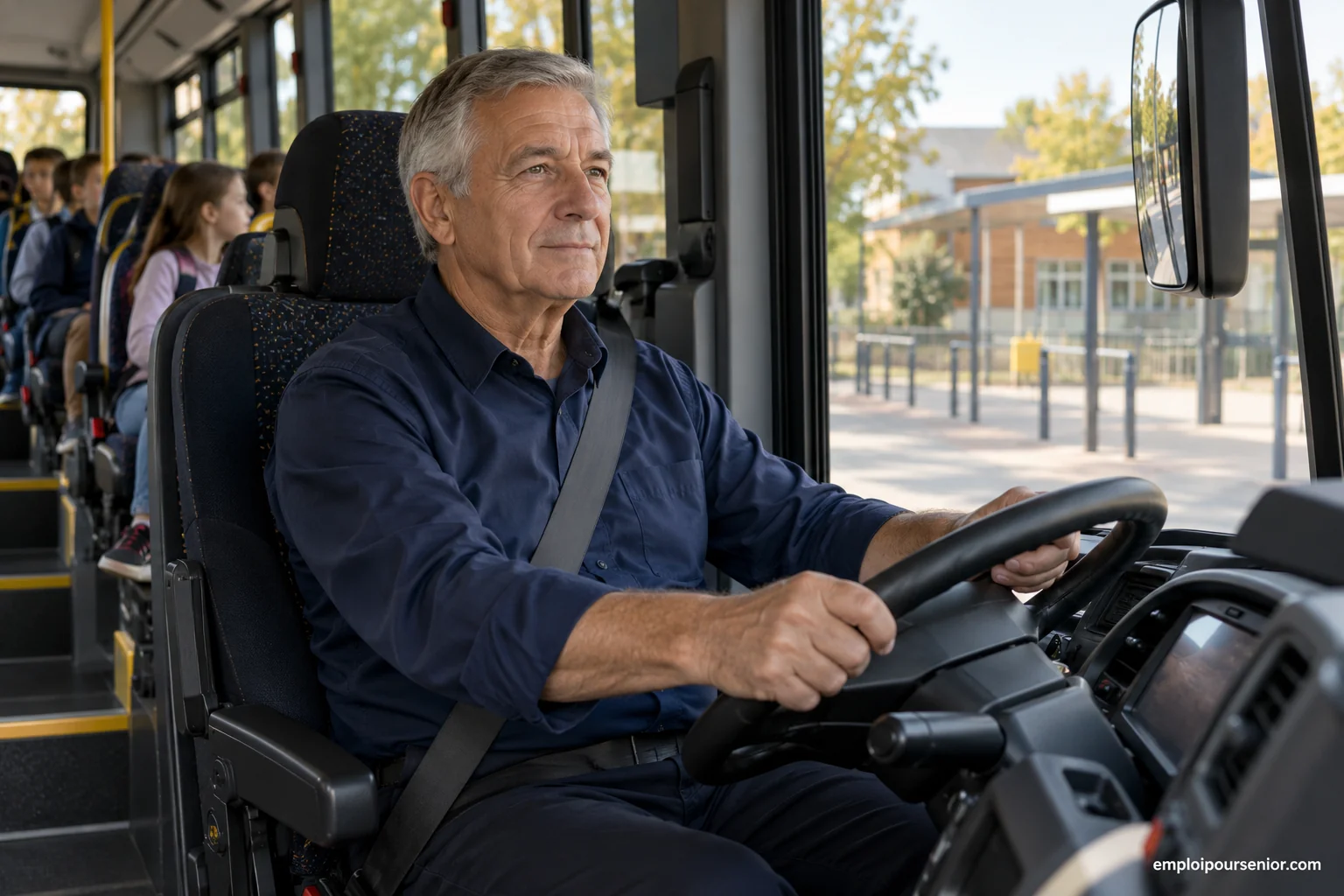
School coach driver jobs for seniors involve taking pupils every day between home, or a pick-up point, and their school. The route is set in advance, the stops are known and the timetable is strict. Before departure the driver checks the vehicle, follows the rules for boarding and dropping off children and reports faults to the employer. School transport firms recruit regularly, including from people changing careers. The work nevertheless demands specific qualifications, a medical fitness check that is followed up and availability for split shifts, so it pays to compare routes in first.
A job built on routine and attention
A school coach driver takes pupils every day between their homes, or a pick-up point, and their school. The route is set in advance, the stops are known and the timetable is strict. That regularity is what makes the job reassuring for some people, but it must never lower vigilance: the surroundings of each stop, pedestrians, other vehicles and the behaviour of passengers all call for constant attention.
Before setting off, the driver checks the vehicle: tyres, lights, doors, seat belts, the state of the interior. He or she follows the rules for picking up and dropping off children, reports faults to the employer and gives an account of any incident.
Required qualifications: personal experience is not enough
Driving a coach is a regulated activity. For a vehicle with more than nine seats, the French category D licence is needed. On top of that come compulsory training courses for professional work: an initial qualification (known in France as FIMO for passenger transport) before taking up a post, then periodic training (FCO), generally renewed every five years.
Minimum ages vary according to the licence category and the type of transport. For a senior, these age rules rarely cause a problem, but fitness for professional driving must be established. Long experience behind the wheel of a car is an asset, though it does not replace professional qualifications. The details of each person’s situation should be confirmed with a training body or a transport company.
Medical fitness and health monitoring
Driving a heavy vehicle or a coach requires regular medical checks. A doctor approved by the prefecture assesses eyesight, hearing, heart and circulation, and more broadly the ability to drive safely. According to information published by the profession, checks become more frequent from age 60, with an annual renewal. Occupational health follow-up comes on top.
For a senior, it is therefore prudent to take stock of your health before paying for training: an unfavourable medical opinion would put the whole plan in doubt. Ask an approved doctor and the future employer exactly which timetable of visits applies in your case.
Routes into the profession
Several routes exist depending on where you start from.
If you already hold the category D licence and the initial qualification
Some operators let you apply directly. Make sure your documents are up to date (licence, certificates, medical visits).
If you are starting from scratch
The professional title of road passenger-transport driver is a recognised pathway. According to one training body, it amounts to several hundred hours, with prerequisites such as a category B licence, a sufficient level of French, medical fitness and entry interviews or tests. Some carriers also offer professionalisation contracts or career-change programmes. Their conditions vary by region and by profile, and certain schemes are reserved for particular age bands.
It is better to compare several offers and to ask what is funded, what is guaranteed in terms of a job afterwards, and what the candidate has to pay.
Split shifts and the school calendar
School transport follows the rhythm of school. Services are often concentrated early in the morning and late in the afternoon, with long breaks in between. The overall span can take up a large part of the day, even though actual driving time is limited.
You also have to cope with school holidays, when activity falls, as well as with outings, trips or regular routes that some employers offer as extra work. To judge an offer, work out your availability over the full working span, not just the driving hours, and ask how the breaks are organised or paid.
A typical day, by way of example
Fictional example, for illustration only. A driver starts at about 6.15 am by checking the coach at the depot. He does a first pick-up round ending at a secondary school, then a second to a primary school. At about 9 am he returns to the depot. The break lasts several hours: he uses it to rest, go over his documents or clean the vehicle.
Late in the afternoon he takes the wheel again for the pupils’ journey home, with the same vigilance as in the morning. He finishes around 6 pm with a check of the vehicle and a short report. This pattern calls for regularity and a good balance between work and private life.
Questions to put to the transport company
Before accepting an offer, it helps to prepare a list of precise questions:
- what type of contract is offered, and for how long;
- what the exact hours are, with breaks and quieter periods;
- who pays for training and on what terms;
- which vehicle is used, with what manoeuvres and where it is parked;
- what back-up is available in case of a breakdown or incident;
- whether there is an escort on board, and what that person’s role is;
- how difficult behaviour by pupils is handled.
The answers let you compare employers without confusing training commitments with job commitments.
Points to watch and alternatives
The job has its constraints: tiredness from early starts, stress in traffic, responsibility for children and a sometimes noisy atmosphere. Sitting for long periods can strain the back, so lifestyle matters.
For those who want to stay in the field without taking the category D licence, other roles exist: escort on school transport, supervisor, driver of small on-demand transport vehicles, minibus driver for a charity or vehicle delivery driver. They do not carry the same requirements, but they draw on a similar taste for punctuality and service.
Frequently asked questions
Can you become a school coach driver after 50?
It is possible, provided you meet the conditions: category D licence, professional training and medical fitness. Some carriers recruit people changing careers, but conditions vary between companies and regions. It is wise to ask directly about recruitment criteria and funding.
What training do you have to complete?
You need the category D licence and professional training, the passenger-transport FIMO, followed by periodic training generally renewed every five years. The professional title of road passenger-transport driver is a recognised pathway. Duration and funding depend on the training body you choose.
Are medical checks more frequent for a senior?
According to information published by the profession, the medical check becomes annual from age 60, whereas it is more widely spaced before. It is carried out by an approved doctor. To learn the exact timetable for your situation, speak to that doctor or to the employer.
Is the job compatible with part-time work?
Sometimes, because school transport is concentrated in certain hours of the day. But the shifts are split and the availability asked for is wide. Work out the real time tied up, breaks included, before comparing an offer with your other commitments.
Can a retiree go back to driving?
It is conceivable, but the French rules on combining work and a pension depend on age, contribution record and whether all pensions have been claimed. These rules are changing. It is better to ask your pension fund before signing a contract, even for part-time hours.
Do you need to be comfortable with children?
Some ease helps, because the driver deals with a group of pupils of different ages. The role itself remains safe driving. Calm firmness, clear instructions and a cool head are useful; tense situations should be reported to the employer rather than handled alone.